

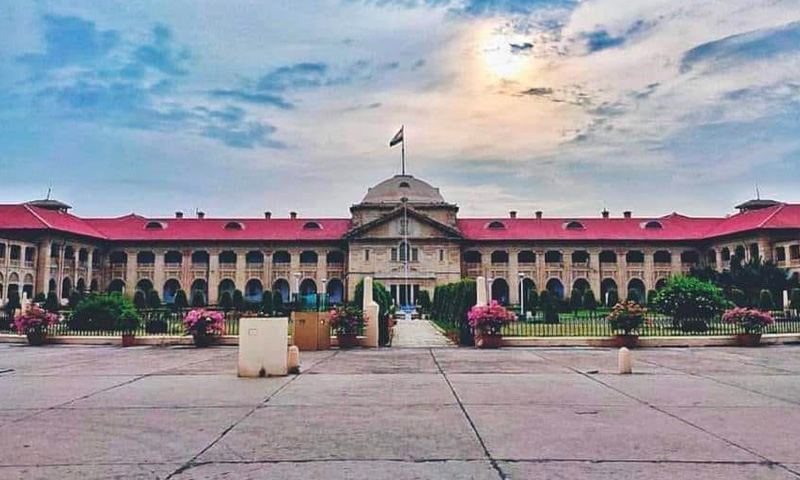
The Allahabad High Court regards matters concerning Members of Parliament and Members of the Legislative Assembly as a distinct class, and as such, these matters are crucial and need to be expeditiously dealt with. This is captured by the Hon’ble Apex Court in a judgment that will be the subject of conversation in this article, and the same is reproduced below:
“These cases have a direct bearing on our political democracy. Hence, there is a compelling need to make every effort to ensure that these cases are taken up on priority and decided expeditiously. Confidence and trust of the constituency in their political representative, be it an MP or an MLA, is necessary for an interactive, efficient and effective functioning of a parliamentary democracy. However, such confidence is difficult to expect when figures, as indicated in the above referred table, loom large in our polity.”
The matters before the Allahabad High Court concerning Members of Parliament or members of the legislative assembly are separately dealt with and monitored. The list of cases can be accessed by clicking on the following link – https://www2.allahabadhighcourt.in/ccmsdata/mpmla/mpmlahome.jsp
The case of Ashwini Kumar Upadhyaya vs. Union of India
The issue of legislators and their criminal history was brought to the Supreme Court by means of Writ Petition (Civil) No. 699 of 2016 titled “Ashwini Kumar Upadhyaya vs. Union of India and another”. In the said case, the Supreme Court vide order dated 14.12.2017 directed that 12 Special Courts be made functional throughout the nation. These Special Courts were constituted in Uttar Pradesh, West Bengal, Delhi, Madhya Pradesh, Maharashtra, Telangana, Karnataka, Andhra Pradesh, Tamil Nadu, and the Andaman and Nicobar Islands. The Department of Justice has also created an online portal for monitoring cases, state-wise. The same can be accessed by clicking on the following link – https://dashboard.doj.gov.in/mp-mla-special-court/index.php
Accordingly, the steps were taken by the Union of India pursuant to the Order dated 14.12.2017, and the Government of Uttar Pradesh issued Government Order (GO) dated 29.06.2018 by means of which one special court was constituted at Prayagraj. However, the aforesaid order of the Apex Court was only an interim measure as the whole idea was quite nascent, and the Hon’ble Apex Court decided the issue pertaining to expeditious disposal of criminal cases on litigators, vide Judgment and Order dated 09.11.2023.
In the aforesaid order, the Hon’ble Apex Court has issued certain directions which are reproduced verbatim:
- Learned Chief Justices of the High Courts shall register a suo-motu case with the title, “In Re: designated courts for MPs/MLAs” to monitor early disposal of criminal cases pending against the members of Parliament and Legislative Assemblies. The suo-motu case may be heard by the Special Bench presided by the Learned Chief Justice or a bench assigned by them.
- The Special Bench hearing the suo-motu case may list the matter at regular intervals as is felt necessary. The High Court may issue such orders and/or directions as are necessary for expeditious and effective disposal of the subject cases. The Special Bench may consider calling upon the Advocate General or the Public Prosecutor to assist the Court.
- The High Court may require the Principal District and Sessions Judge to bear the responsibility of allocating the subject cases to such court or courts as is considered appropriate and effective. The High Court may call upon the Principal District and Sessions Judge to send reports at such intervals as it considers expedient.
- The designated courts shall give priority: (i) first to criminal cases against MP’s & MLA’s punishable with death or life imprisonment then to (ii) cases punishable with imprisonment for 5 years or more, and then hear (iii) other cases. The Trial Courts shall not adjourn the cases except for rare and compelling reasons.
- The learned Chief Justices may list cases in which orders of stay of trial have been passed before the Special Bench to ensure that appropriate orders, including vacation of stay orders are passed to ensure commencement and conclusion of trial.
- The Principal District and Sessions Judge shall ensure sufficient infrastructure facility for the designated courts and also enable it to adopt such technology as is expedient for effective and efficient functioning.
- The High Courts shall create an independent tab on their website providing district-wise information about the details of the year of filing, number of subject cases pending and stage of proceedings. We make it clear that while monitoring the subject cases, the Special Bench may pass such orders or give such additional directions as are necessary for early disposal of the subject cases.
Direction of Expeditious Disposal – Power of superintendence
Section 529 of the Bhartiya Nagarik Suraksha Sanhita, 2023 provides for the duty of the High Court to exercise continuous superintendence over trial courts.
529. Duty of High Court to exercise continuous superintendence over Courts.—Every High Court shall so exercise its superintendence over the Courts of Session and Courts of Judicial Magistrates subordinate to it as to ensure that there is an expeditious and proper disposal of cases by the Judges and Magistrates.
The Hon’ble Allahabad High Court in the case of Vishnu Mishra vs. State of U.P. and another, (Application under Section 529 BNSS No. 712 of 2025) has followed the mandate of Ashwini Kumar Upadhyaya (Supra), and interpreted the law on the point of the power of the high court to direct the trial court to expedite the trial.
The Hon’ble Allahabad High Court in the aforesaid case directed to conclude the trial of the case, as expeditiously as possible, preferably within a period of one year from the date of production of the certified copy of the order in accordance with law, without granting any unnecessary adjournment to either of the parties, if there is no legal impediment.
The Hon’ble Allahabad High Court further reconciled the law as settled in High Court Bar Association vs. State of U.P. and others (2024) 6 SCC 267 with the directions in Ashwini Kumar Upadhyaya (Supra).