

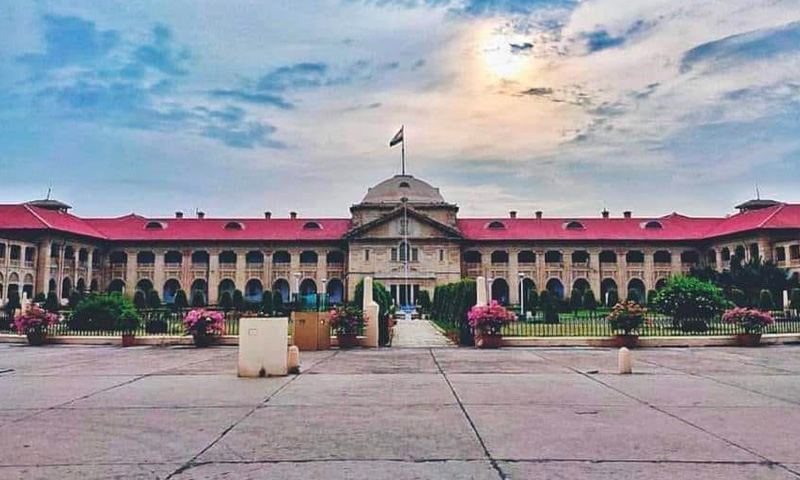
Courtesy: Mayank Pratap Singh
The Uttar Pradesh Prevention of Cow Slaughter Act, 1955 was enacted to prohibit and prevent the slaughter of cow and its progeny in the State. The law was enacted in consonance with the directive principles of state policy, specifically Article 48 of the Constitution of India.
With the development of transport and its role in the commission of the offence under the Act, an Amendment was enacted to the Statute by means of which Section 5A was inserted in the Statute. Section 5A of the U.P. Prevention of Cow Slaughter Act, 1955 deals with the regulation of transport of cow, its progeny, or beef. It prohibits taking cows, bulls, or bullocks from within the State of Uttar Pradesh to outside the State without a government permit. Section 5A(7) further provides for confiscation and release of vehicles by the District Magistrate. Section 5A(11) provides that where the Act and the Rules are silent, the provisions of the Criminal Procedure Code shall be applicable.
Can the vehicle be confiscated merely if a cow, or its progeny, is transported within Uttar Pradesh?
No. The Allahabad High Court has consistently held that transport of cattle within Uttar Pradesh does not attract any offence under the Act. This position was established in Kailash Yadav v. State of U.P. where the Court held that the movement of cows within Uttar Pradesh does not constitute any offence, and as such, such a case does not invoke Section 5A of the Act.
In Phool Chand Shahu v. State of U.P. (2023), the Allahabad High Court set aside a confiscation order because the cattle were seized within the state. The vehicle had not crossed state borders, and there was no proof the animals were being taken outside UP.
In Law Kush Kumar Shukla v. State of U.P. (2026), the Hon’ble High Court quashed the confiscation order on the ground that nothing on record showed the cows were taken outside Uttar Pradesh and that transportation of cows within the state is not a violation of any provision of the Act, as held in the landmark judgment of Kailash Yadav vs. State of Uttar Pradesh.
When can an order of confiscation be passed?
The order of confiscation may be passed by the District Magistrate under Section 5A(7) of the Act, when the conditions prescribed therein stand fulfilled. The conditions to be fulfilled are as follows:
- The vehicle must be used for transport of beef or cow and its progeny
- Any provision of the U.P. Prevention of Cow Slaughter Act, or the relevant rules i.e. the U.P. Prevention of Cow Slaughter Rules, 1964 should be violated by such transport
The Allahabad High Court has made it clear in precedent that confiscation does not follow automatically from seizure. The commission of an offence is a required ingredient before power under Section 5A(7) of the Act can be invoked. An order of confiscation should not be passed automatically, and mere suspicion or physical possession of cattle in a vehicle is not sufficient.
The Allahabad High Court, in a slew of judgments, has set aside the confiscation orders, and directed for release of vehicle in favour of the owner of the vehicle invoking Article 19(1)(g) of the Constitution of India, Article 300A of the Constitution of India, and the general principle that vehicles should not be held in custody for long periods of time due to which they may degrade in quality.
What is the impact of Acquittal on Confiscation Proceedings?
The question of what happens to a confiscation order after the accused is acquitted in the criminal trial has been addressed by the Supreme Court in Abdul Vahab v. State of Madhya Pradesh [(2022) 12 SCC 98], wherein the Hon’ble Supreme Court examined a case where all accused had been acquitted at trial since intent to slaughter was not proved. Despite the acquittal, the District Magistrate ordered confiscation. The Supreme Court held that the District Magistrate should have taken the acquittal into account and that ignoring it while retaining the vehicle amounted to an arbitrary deprivation of property in violation of Article 300A of the Constitution of India.
How can you challenge the order of confiscation passed by the District Magistrate?
The Act originally provided no statutory appeal against a District Magistrate’s confiscation order. Hence, the order was challenged before the Learned Sessions Court by means of Criminal Revision under Section 397 read with Section 401 of the Criminal Procedure Code, now Section 438 read with Section 442 of the Bhartiya Nagarik Suraksha Sanhita. Against the revisional order, one may approach the Allahabad High Court, either by means of a Petition under Article 227 of the Constitution of India, or by means of an Application under Section 528 of the Bhartiya Nagarik Suraksha Sanhita (earlier Section 482 of the Criminal Procedure Code). One may have also preferred a Writ Petition before the Hon’ble Allahabad High Court challenging the order of confiscation directly, however, it is always wise to exhaust the alternative remedy.
However, on 15.10.2024, the Government of Uttar Pradesh issued a notification under Section 5A(5) of the Act by means of which the Divisional Commissioner was vested with revisional jurisdiction to call for and examine the record of any case of confiscation decided by the District Magistrate under Section 5A of the Act. In the case of Nitesh Kumar vs. State of U.P. and others 2025 SCC Online All 4252, the Allahabad High Court took the notification on record and held that appropriate remedy may be availed in accordance with the notification dated 15.10.2024.
It is clear that upon availing the remedy before the Divisional Commissioner, if the vehicle owner is still aggrieved, then both the orders may be challenged before the Hon’ble Allahabad High Court by means of a petition either under Articles 226 or 227 of the Constitution of India, or an application under Section 528 of the Bhartiya Nagarik Suraksha Sanhita 2023.
It is thus proper to challenge the order of confiscation before the Divisional Commissioner, as provided by the Notification dated 15.10.2024 in accordance with Section 5A(5) of the Act, and if then too, one is aggrieved, both the orders may be challenged before the Hon’ble Allahabad High Court.